
Getting an enquiry is only the beginning.
A potential customer might call, complete a website form, send a WhatsApp message or request a quote. But if that enquiry isn’t handled properly, the customer can easily move on to another business.
This is particularly important for busy local businesses. When you’re working on jobs, travelling between customers or dealing with existing clients, responding to every new enquiry immediately isn’t always easy.
The problem is that potential customers may be contacting several businesses at the same time.
A better follow-up process can help make sure valuable enquiries don’t simply disappear.
Here are eight common follow-up mistakes that could be costing your business customers.
1. Taking Too Long to Respond
Someone who contacts your business is usually looking for help with something now — or at least wants to start getting information.
If their enquiry sits unanswered for a long time, they may contact another business.
You don’t necessarily need to provide a complete quote immediately.
Even a short acknowledgement can reassure the customer that their enquiry has been received.
For example:
“Thanks for getting in touch. We’ve received your enquiry and will get back to you as soon as possible.”
The important thing is making sure the customer knows their message hasn’t disappeared.
2. Missing Calls Without Having a Follow-Up Process
For many local businesses, phone calls remain an important source of enquiries.
But you can’t always answer.
A plumber may be underneath a sink. A kitchen fitter may be using tools. A locksmith may be with another customer. A garage may have staff working on vehicles.
The problem isn’t necessarily missing the initial call.
The bigger problem is forgetting to follow it up.
You need a simple process for identifying missed calls and returning them when you’re available.
Where appropriate, an automatic text message can also acknowledge the missed call and tell the customer you’ll get back to them.
3. Letting Enquiries Sit Across Different Channels
Customers don’t all contact businesses in the same way.
One person may telephone.
Another might use your website form.
Someone else might send an email, Facebook message or WhatsApp message.
Without a system, enquiries can become scattered across several places.
That makes it much easier to forget someone.
You don’t necessarily need complicated software when you’re starting out.
Even a simple lead-tracking process that records:
- Customer name
- Contact details
- What they need
- Date of enquiry
- Last contact
- Current status
- Next follow-up
can make a significant difference.
The important thing is having somewhere you can quickly see which enquiries still require action.
4. Sending a Quote and Never Following Up
This is one of the biggest missed opportunities for many service businesses.
A customer asks for a quote.
You spend time preparing it.
You send it.
Then nothing happens.
It’s easy to assume that the customer wasn’t interested.
But there may be many other reasons they haven’t replied.
They might be busy, still comparing options, waiting to speak to someone else or simply have forgotten.
A polite follow-up could bring the conversation back to life.
For example:
“Hi, just checking that you received the quote we sent over. Please let us know if you have any questions or if there’s anything you’d like us to clarify.”
You don’t need to chase customers endlessly.
But sending a sensible follow-up after a quote can prevent genuine opportunities from being forgotten.
5. Not Knowing Which Enquiries Need Following Up
If you’re relying entirely on memory, eventually something will be missed.
Imagine receiving ten enquiries during a busy week.
Some need quotes.
Some are waiting for you to call back.
One customer wants an appointment next week.
Another said they would think about the quote.
By Friday, remembering exactly where every conversation stands becomes difficult.
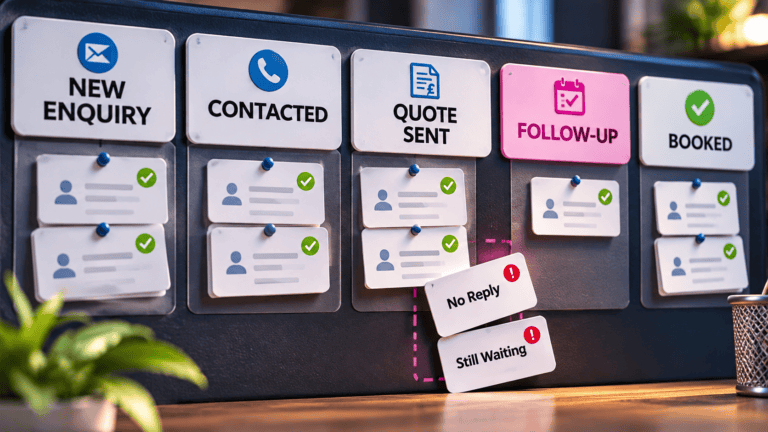
This is why even a basic enquiry pipeline can help.
For example:
New Enquiry → Contacted → Quote Sent → Follow-Up Needed → Booked → Not Proceeding
At a glance, you can see what needs attention instead of searching through messages and trying to remember what happened.
6. Making It Difficult for Customers to Take the Next Step
Sometimes businesses respond to an enquiry but don’t clearly tell the customer what to do next.
The conversation simply stops.
Try to make the next step obvious.
Depending on your business, that might be:
- Book an appointment
- Arrange a site visit
- Send photographs
- Confirm an address
- Accept a quotation
- Choose an available date
- Call to discuss the work
Clear next steps make it easier for customers to continue the conversation.
Instead of:
“Here’s your quote.”
you might say:
“I’ve attached your quote. If you’d like to go ahead, reply to this message and we’ll arrange a suitable date.”
Small changes like this can make the enquiry process easier for the customer.
7. Treating Every Enquiry Exactly the Same
Not every enquiry is at the same stage.
Someone asking a general question may need different follow-up from someone who has already requested a quote.
Someone who needs an emergency repair may need a much faster response than someone planning a kitchen renovation several months from now.
A useful follow-up system should therefore help you understand:
Who needs a response?
Who needs a quote?
Who needs following up?
Who is ready to book?
Who has decided not to proceed?
This helps you spend your time on the right conversations rather than treating every contact as identical.
8. Trying to Remember Everything Manually
When a business is small, it’s tempting to manage everything through memory, your phone and a collection of messages.
That may work when you’re receiving only a few enquiries.
As enquiry volume grows, it becomes harder.
This is where simple systems and carefully chosen automation can help.
For example, you may be able to automate or simplify:
- Enquiry acknowledgements
- Missed-call responses
- Appointment reminders
- Follow-up reminders
- Review requests after completed work
- Recording certain customer information
The goal isn’t to replace genuine customer communication with robots.
It’s to reduce repetitive administration and make it less likely that a potential customer gets forgotten.
A Better Enquiry Process Doesn’t Need to Be Complicated
You don’t necessarily need an expensive CRM or complicated automation system.
Start with the customer journey.
A simple process might look like this:
New enquiry
↓
Acknowledge the enquiry
↓
Record the customer’s details
↓
Contact the customer
↓
Provide the quote or next step
↓
Set a follow-up date
↓
Follow up if necessary
↓
Booked or closed
Once you have a process that works, you can decide which repetitive parts are worth automating.
Look at What Happens After Someone Contacts You
Businesses often spend money trying to generate more website traffic, Google visibility or advertising enquiries.
But before spending more money attracting leads, it’s worth looking at what happens to the enquiries you’re already receiving.
Ask yourself:
- How quickly do we normally respond?
- What happens when we miss a call?
- Where are website enquiries recorded?
- Do we follow up quotations?
- Can we see which potential customers need contacting?
- Do customers always know their next step?
- How many enquiries disappear without a clear outcome?
Fixing these gaps can make your existing marketing more valuable because you’re making better use of the opportunities it already generates.
Build a Simple Follow-Up System
A good system should make running your business easier — not give you more administration.
For many small businesses, the starting point can be surprisingly simple:
Capture the enquiry → Record it → Respond → Set the next action → Follow up → Track the outcome
Once that foundation is working, reminders and automation can be added where they genuinely save time.
The result is a clearer process for both you and your potential customers.
Request Your Free Local Marketing Audit
Are potential customers finding your business but disappearing somewhere between the initial enquiry and becoming a customer?
Our free local marketing audit looks at your Google presence, website, reviews and enquiry process to identify practical gaps that could be costing you opportunities.
No obligation. Just practical recommendations based on what we find.
