
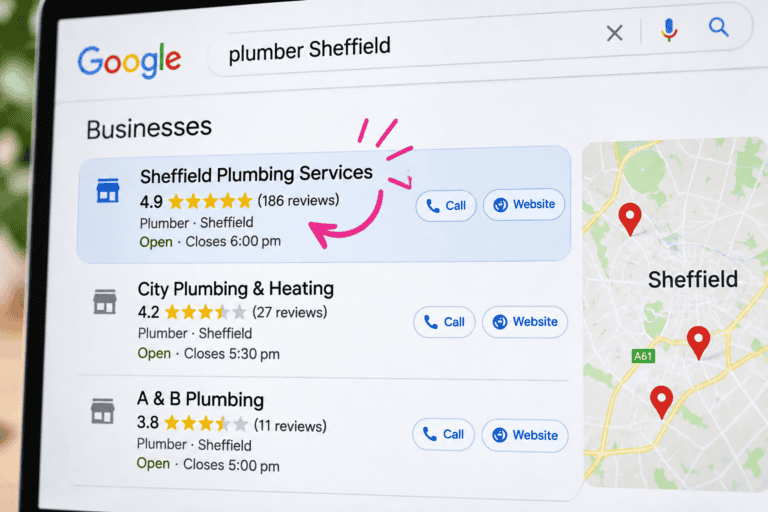
Customer reviews can have a major influence on whether someone chooses to contact a local business.
A potential customer may find your business on Google, visit your website and compare your services with several competitors. If another business has significantly more recent positive reviews, that can influence who they decide to contact.
But many good local businesses struggle to generate reviews consistently — even when their customers are happy with the work.
Often, the problem isn’t the quality of the service. It’s simply that there isn’t a clear and consistent process for asking customers for feedback.
Here are eight common reasons your business may not be getting enough Google reviews — and what you can do about them.
1. You’re Not Asking Customers for Reviews
One of the simplest reasons businesses don’t receive many reviews is that they rarely ask for them.
A satisfied customer may be very happy with the service you’ve provided, but leaving a Google review probably isn’t at the top of their to-do list.
Unless you ask, they may simply forget.
Make asking for feedback a normal part of completing a job. The best time is usually shortly after the work has been completed, while the customer’s experience is still fresh.
A simple request can be enough:
“If you’re happy with the work we’ve done, we’d really appreciate it if you could leave us a Google review.”
The aim isn’t to pressure customers. It’s simply to make happy customers aware that their feedback is valuable to your business.
2. You’re Making It Too Difficult
Even a customer who intends to leave a review may give up if they have to search for your business, find the correct Google profile and work out where to leave feedback.
Make the process as easy as possible.
Provide customers with a direct link that takes them to the appropriate Google review process rather than simply saying, “Please review us on Google.”
You can share the link through methods such as:
- Text message
- A follow-up message after completing the job
The fewer steps involved, the more convenient the process becomes for the customer.
3. You’re Waiting Too Long to Ask
Timing matters.
If you contact a customer several weeks after completing the work, the experience is no longer as fresh in their mind.
Where appropriate, ask shortly after the job or service has been completed and the customer has had an opportunity to see the result.
For example, a trades business might send a polite follow-up later that day or the following day.
A simple process could be:
Complete the job → Confirm the customer is satisfied → Thank them → Send the review link
This turns asking for feedback into a normal part of your customer process rather than something you remember occasionally.
4. You’re Asking Inconsistently
Many businesses ask for reviews when they remember.
One week they might ask five customers. Then they get busy and don’t ask anyone for the next two months.
This makes review growth inconsistent.
Instead, build the request into your normal workflow.
For example:
Job completed → Customer follow-up → Review request
You don’t necessarily need complicated software to start doing this. A simple checklist, CRM reminder or follow-up process can help make sure the request isn’t forgotten.
As your enquiry and customer volume increases, parts of this process can potentially be automated.
Consistency is usually more valuable than occasionally trying to generate lots of reviews at once.
5. Your Review Request Sounds Too Complicated
Customers are more likely to respond when the request is short and clear.
You don’t need a long message explaining why reviews matter to your business.
Something simple may work better:
“Thanks again for choosing us. If you’re happy with the work, we’d really appreciate your feedback. You can leave us a Google review here: [review link]”
Keep it polite and easy to understand.
Avoid repeatedly chasing customers who don’t respond. A review request should feel like a reasonable invitation, not an obligation.
6. You’re Not Responding to the Reviews You Already Have
Getting a review shouldn’t be the end of the process.
Responding professionally shows customers that you’re paying attention to their feedback.
For positive reviews, a simple personalised thank-you is usually enough.
If someone leaves a negative review, avoid responding emotionally or arguing publicly.
A calm response can acknowledge the concern and, where appropriate, invite the customer to contact the business directly so the issue can be discussed.
Remember that your response isn’t only being read by the person who left the review.
Future potential customers may read it too.
How you respond can therefore influence their impression of your business.
7. You’re Not Making Reviews Part of the Customer Journey
Reviews work best when they are treated as part of the customer experience rather than as a separate marketing task.
Think about what happens from the moment someone first contacts your business:
Enquiry → Quote or booking → Service delivered → Customer follow-up → Review request
This creates a repeatable process.
For a local trades business, for example, the final stage of every completed job could include:
- Confirm the customer is happy
- Thank them for their business
- Send any final paperwork or information
- Send the review link
- Record that the request has been sent
Once this becomes routine, generating reviews becomes much easier to manage.
8. You’re Trying to Take Shortcuts
Building a strong reputation takes time.
Buying fake reviews, offering inappropriate incentives or trying to manipulate customer feedback can create serious problems and may breach Google’s policies.
Focus instead on genuine reviews from real customers who have actually experienced your service.
A smaller collection of authentic, useful reviews is far more valuable than a profile that looks artificially manipulated.
The goal is to build a reputation that reflects the real quality of your business.
Why Google Reviews Matter for Local Businesses
Reviews do more than display a star rating.
They can help potential customers understand what it’s like to work with your business.
A customer considering a plumber, kitchen fitter, electrician, locksmith, cleaner or garage may look at:
- How many reviews the business has
- How recent they are
- What customers actually say
- Whether the business responds professionally
- Whether the feedback appears genuine
This can influence whether they click through to your website, call you or choose another business.
Reviews are therefore an important part of building trust during the customer’s decision-making process.
Don’t Focus Only on the Number of Reviews
It’s easy to become obsessed with reaching a particular review count.
But reputation management isn’t simply about collecting the largest possible number.
A healthier approach is to build a steady flow of genuine customer feedback over time while continuing to provide a good service.
That means focusing on:
- Genuine customer experiences
- Consistent review requests
- Recent feedback
- Professional responses
- Making the process easy for customers
This creates a much more sustainable reputation strategy.
Create a Simple Review Process
You don’t need to make this complicated.
Start with a basic system:
Complete the work
↓
Confirm the customer is satisfied
↓
Thank the customer
↓
Send a direct Google review link
↓
Respond when the review arrives
↓
Keep track of which customers have been asked
Once this works consistently, you can look at whether reminders or parts of the process should be automated.
The important thing is to establish the process first.
Request Your Free Local Marketing Audit
Not sure whether your online reputation is helping or holding your business back?
Get a free review of your Google presence, website, reviews and enquiry process, with practical recommendations on what you could improve first.
No obligation. Just straightforward recommendations based on what we find.
